
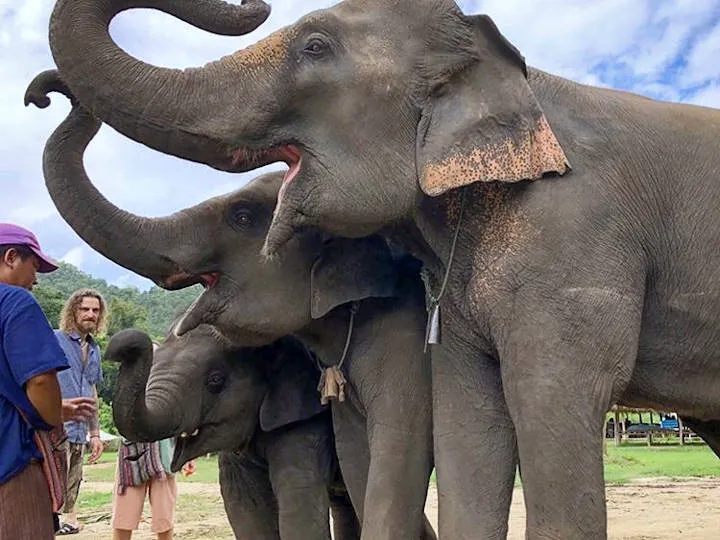

You often ask me this question:
“Which elephant camp do you recommend?”
And the truth is, It's not a question of name... but of conscience.
Not all camps are equal.
And some, despite a good communication, remain far from any real respect for the animal.
So I'm going to explain to you Simply, concretely, without beating about the bush How to choose.
What needs to be understood above all else
An elephant in Thailand isn't just a tourist animal.
It is:
- a being Extremely intelligent
- an animal Emotional and social
- who has often lived captivity, labour or exploitation
Your choice of side has a direct impact on his/her/their life
What to absolutely avoid
1. Elephant rides

- The “nacelle” (seat) exerts enormous pressure on the spine
- The elephant's back is not made for carrying weight
- This leads to pain, injury, deformities
Even if “everyone does it”...
This is not acceptable today
2. The shows
- Painting
- Football
- “Fun” numbers”
Behind that:
- forced dressing
- deprivation
- fear
3. Permanent chains
- Key element to observe
- An elephant Chained up all day = bad sign
Beware of “fake ethics”
Today, many camps use:
sanctuary“
Gentle images
a marketing speech
But in reality:
- they continue certain practices
- They are limiting the elephants' freedom
- they favour tourist numbers
Look at the actions, not the words
Signs of a good camp
No mounting
Never
2. Gentle interaction
- Feeding
- walk beside
- Observation
3. Relative freedom
- elephants not chained permanently
- possible moves
4. Respect the pace/rhythm
- No pressure
- no performance
- no obligation to contact
5. Supervision by Mahouts
- Old relationship
- knowledge of the animal
- mutual respect
What you can experience at an ethical camp

- Feeding the elephants
- Walk beside them
- To observe them in silence
- Sometimes accompany them in the water
These are not activities
It's a meeting
Why am I telling you this
Because I've seen both sides.
And because at one point,
You can no longer pretend not to know.
Why I Recommend Elephant Steps
Elephant Steps Chiang Rai
Because:
- deeply respectful approach
- Real immersion, not tourism
- Sincere human-animal bond
- slow, conscious rhythm
But above all:
you are not consuming an activity
You are going through something
And beyond... Elephant Therapy
'as-tu déjà entendu parler de'’Elephant therapy ?
This is no ordinary visit.
It is another way of meeting the elephant... and of meeting oneself.
An immersion
An inner experience
A moment out of time
And what if, instead of spending a few hours with them,
Were you living for a full week in immersion?
The elephant then becomes a mirror.
It returns to you:
- your rhythm
- your fidgeting
- you need control
And sometimes…
It simply teaches you to slow down
Another way to experience the encounter
If you feel it calls to you,
You can discover this approach in more detail here:
A space to understand, to feel… and perhaps to consider another way of experiencing this encounter.
How do you make your choice concretely
Before booking, ask yourself these questions:
- Do we ride on elephants?
- Are they free?
- Do I smell respect... or business?
- Do I want to “do an activity”... or have an encounter?
True luxury today
It is not
- a photo
- an activity
- a ticked box
It's a fair experience
Conclusion
To choose a herd of elephants,
it's also choosing The world you are encouraging.
You can contribute to:
- protect
- respect
- to exploit
And once you know...
You choose differently
Are you still hesitating or do you want advice on choosing a more ethical elephant camp in Thailand? Don't hesitate to contact us. Contact.
FAQ – Choosing an Elephant Camp in Thailand
Should elephant rides be avoided?
Yes. An elephant's back is not designed to carry weight, especially with a howdah. This can cause pain and injuries. Today, this practice is strongly discouraged.
How to recognise an ethical camp?
An ethics camp:
- does not offer a mount
- Focus on observation and gentle interactions.
- respect the pace of the elephants
- limit groups
- avoid the shows
Are sanctuaries still ethical?
No. The term “sanctuary” is often used for marketing purposes. It is important to observe the real practices on the ground.
Can we touch or bathe with elephants?
In some camps, yes, but it must remain controlled and respectful. The important thing is that the elephant is not forced and that the interaction remains natural.
Why are elephant shows problematic?
They generally involve training based on coercion. “Fun” behaviours are learned under pressure.
Are elephants free to roam in the camps?
Rarely completely free, but in a good enclosure, they must be able to move around and not be permanently chained up.
Can one visit a camp with children?
Yes, if the camp is ethical and safe. It's even a great educational experience.
What is the best experience with elephants?
The most authentic experiences are:
- the observation
- walking alongside them
- long immersions (full day or several days)


